

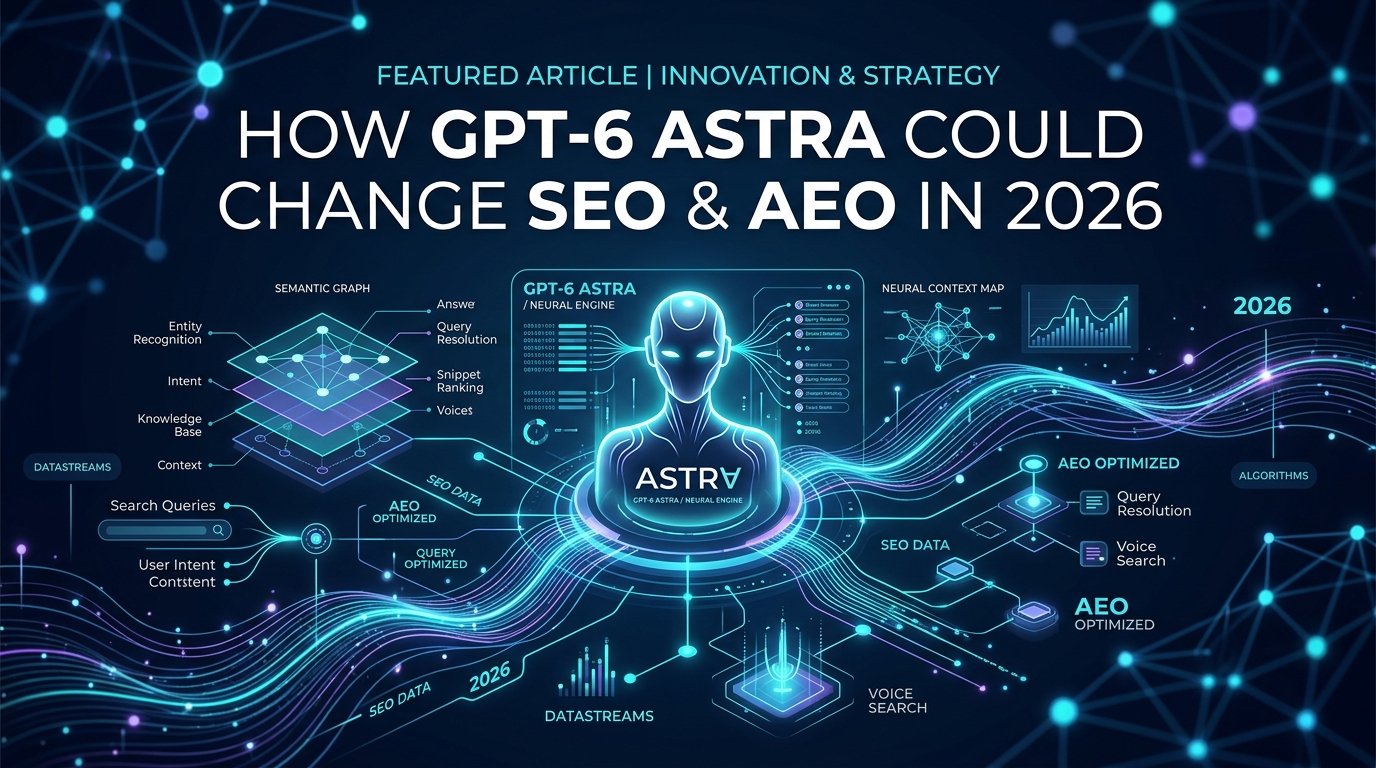
Search is entering a new phase. For years, search engine optimization has been built around a single objective: help a webpage rank, earn the click, and bring the user to the site. That objective is no longer sufficient on its own.
AI-powered search is changing what happens between a user's question and the information they receive. Rather than returning a list of links, increasingly capable AI systems can browse websites, compare information across sources, reason through multiple perspectives, and generate a direct response.
GPT-6 Astra, OpenAI's latest model, represents a significant step in that direction. The company positions Astra as a system built for advanced browsing, computer use, reasoning, and complex multi-step workflows. Its API documentation lists a context window of 10,50,000 tokens (1.05 million tokens), allowing it to process far larger volumes of information within a single task than earlier models could manage.
For marketers, this creates a fundamental shift in how visibility should be defined. Below, we examine the four critical shifts outlining how GPT-6 Astra could reshape the way businesses approach search visibility in 2026.
Core Takeaways: The 2026 Search Paradigm
- Shift from Retrieval to Synthesis: AI models browse and compile multi-source answers rather than simply listing 10 blue links.
- 1.05M Context Window: GPT-6 Astra digests massive cross-page content simultaneously, prioritizing structural clarity over keyword density.
- Convergence of SEO & AEO: Winning visibility requires direct answers, strong machine-readable structured data, and uncompromising E-E-A-T.
- Three-Layer Architecture: Successful brands execute Traditional SEO, Answer Engine Optimization (AEO), and AI/GEO visibility in unison.
Shift 01
1. From Ranking to Being the Answer: Astra's Agentic Browsing Redefines Discovery
Traditional search has always worked around retrieval. A user submits a query, the search engine retrieves relevant pages, ranks them, and presents the results, and the user chooses which one to open. AI-powered discovery works differently. Instead of returning ten links for a question such as "Which is the best seo company in kerala?", an AI system can research multiple sources, compare features, interpret the user's requirements, and produce a synthesized recommendation directly.
This changes the value of a webpage. Content no longer needs to be solely the page a user clicks; it may instead become the material an AI system draws upon to construct its answer. This is the essential shift from conventional SEO toward Answer Engine Optimization (AEO).
The New Visibility Battle
Consider two websites addressing the same topic:
Website A (Traditional Keyword Stuffer)
Ranks highly for target keywords through legacy backlinks and repetitions, but offers generic, padded, repetitive information with low original value.
Website B (AEO & Entity Optimized)
Provides a well-researched explanation, states facts clearly, contributes original insight, and demonstrates strong authority signals that machines easily parse.
In a purely traditional ranking environment, Website A might still perform adequately through conventional SEO signals alone. In an agentic search environment, however, Website B is far more likely to be favored, simply because its information is easier for an AI system to understand, evaluate, and incorporate into a response.
OpenAI has described Astra as a model designed for complex browsing and multi-step work, rather than one that relies solely on static, pre-trained knowledge. That distinction matters for marketers, because AI systems are increasingly positioned as research intermediaries: the user asks a question, the AI researches it, compares sources, and delivers an answer with the business's website serving, at best, as one contributor to that process.
The Effect on Zero-Click Searches
This dynamic puts further pressure on the traditional notion of organic traffic. A user who once searched "Which is the best seo consultant kerala?" might have opened a blog post, read it in full, and gone on to explore related pages. If an AI-generated answer now provides a sufficiently complete explanation within the search experience itself, that click may never take place.
This does not render website traffic irrelevant, but it does change why people visit websites in the first place. Straightforward informational queries may increasingly be resolved without a click, while sites offering deeper expertise, original research, interactive tools, bespoke products, and strong brand experiences are likely to gain importance once the initial AI-generated answer has been given.
Consequently, SEO reporting in 2026 needs to extend beyond keyword rankings, organic clicks, impressions, and click-through rate. Businesses should also be asking:
- Is our brand mentioned in AI-generated answers?
- Is our website cited as an authoritative source in AI synthesis?
- Which pages are being referenced by agentic browsers?
- Which specific user prompts trigger our brand's appearance?
- Which competitors are cited instead, and what sentiment do AI systems associate with our brand?
Ranking remains important, but being selected as a source for an answer is becoming an additional, and increasingly consequential, layer of search visibility.
Shift 02
2. Content Structuring for Machine Comprehension: What Astra Actually Rewards
One of the more important lessons for marketers is that more content does not automatically mean better content. GPT-6 Astra's 1.05-million-token context window is vast compared with the short-context interactions typical of earlier systems, which means sophisticated AI models can now work with substantially larger volumes of information and cross-reference material across multiple documents and pages at once.
For content creators, this presents a different optimization challenge: the goal is no longer to produce content that simply contains the right keywords, but content that is easy to understand, verify, and extract.
Place the Answer Close to the Question
If a heading asks "What is Answer Engine Optimization?", there is little value in making a reader or an AI system work through several paragraphs of introduction before reaching the definition. It is more effective to lead with the answer directly:
Direct AEO Answer Pattern:
Answer Engine Optimization (AEO) is the practice of structuring and optimizing content so that AI-powered search and answer engines can understand, retrieve, and potentially cite it when responding to user questions.
The explanation can then be expanded afterward. This structure benefits human readers and AI systems alike.
Build Content Around Questions
Rather than building an article solely around a standalone keyword such as "CRM software," it is more effective to organize sections around the actual questions users are asking:
- What is CRM software?
- How does it work in modern cloud ecosystems?
- What are its tangible business benefits?
- What does enterprise implementation cost?
- Who needs it, and what should a business consider before choosing one?
This approach creates a logical information architecture and gives AI systems clearly identifiable question-and-answer relationships to draw from.
Use Structured Data Where Appropriate
Structured data provides additional, machine-readable context about a webpage. Depending on the content, businesses may consider schema types such as FAQPage, HowTo, Product, Organization, Article, LocalBusiness, or Review.
Schema markup is not a guaranteed shortcut to AI citation, it offers no such promise — but accurate structured data genuinely helps search systems understand entities, relations, and what a page represents.
Move Beyond Word Count as a Strategy
One of the most persistent mistakes in content marketing has been treating length as a ranking signal in itself. A three-thousand-word article is not inherently superior to one of twelve hundred words; if eight hundred of those words simply repeat a keyword or pad the introduction, they add little real value.
AI systems capable of processing large volumes of context evaluate content on its substance rather than its length. Information quality and structural clarity are paramount. The winning formula is not more words paired with more keywords, but better information delivered through clearer structure, stronger evidence, and genuine expertise.
Shift 03
3. Trust, Citation, and E-E-A-T in an Agentic Search Era
If AI systems are to answer questions on a user's behalf, a critical question follows: which sources should they trust? This makes authority and credibility more important than ever. Google's E-E-A-T framework (Experience, Expertise, Authoritativeness, and Trustworthiness) has already pushed marketers toward higher-quality content, and agentic AI makes that principle still more relevant.
Consider an AI system researching "What are the best universities for studying AI in Dubai?" It might encounter a university's official website, an education consultancy, a personal blog, a forum discussion, an outdated article, a comparison site, and a news publication, all within the same search. The model must determine which of these sources is genuinely useful and trustworthy — which means content should not merely state information, but should make it easy for a reader, human or machine, to understand why that information deserves trust.
Author Credibility Matters
For expertise-driven content, the author should be visible: full name, professional background, relevant qualifications, experience, linked profiles, and editorial context. An identifiable industry professional carries a materially higher credibility signal than an anonymous page filled with generic statements.
Cite Sources for Factual Claims
Any claim involving statistics, empirical research, official regulations, pricing benchmarks, or industry developments must be supported by a credible source. Strong content makes evidence easy to identify, rather than leaving the AI or human reader to verify claims independently.
Keep Information Current
In fast-moving fields like technology, AI, SEO, finance, and digital marketing, outdated articles become liabilities. Important pages should be reviewed regularly with updated data, references, examples, and visible revision dates.
Crawlability Still Matters
Even the most authoritative content cannot contribute to AI discovery if machines cannot access or parse it. Clean semantic HTML, sensible navigation, fast loading, accessible content, and indexable pages are non-negotiable foundations.
Shift 04
4. The New SEO/AEO Toolkit: Getting Technically “Astra-Ready”
The final shift is operational. Businesses need to begin treating AI visibility as a measurable component of their search strategy. There is no single switch that makes a website “Astra-ready”; instead, the goal is to build an AI-ready website and content ecosystem across several fronts.
Working with experienced SEO experts in Kerala can help businesses adapt their existing SEO strategy to these emerging AI-search requirements while maintaining strong technical foundations.
Make Important Content Accessible to Crawlers
Review the website from a machine's perspective. Confirm that search and AI systems can readily access product information, service descriptions, pricing, FAQs, author information, company details, location data, and key statistics. Essential information should never sit behind unnecessary technical barriers or complex client-side scripts where automated crawlers may struggle.
Build Clean Page Architecture
Every important page should follow a clear hierarchy: heading, subheading, answer, explanation, evidence, rather than an undifferentiated block of text surrounded by unrelated keywords. A professional SEO agency in Kerala can help audit and restructure website content to make it clearer for both users and search engines.
Use Structured Data Purposefully
Relevant schema markup should be implemented accurately and only where it genuinely represents the page's content, rather than added indiscriminately. The objective is machine understanding, not schema for its own sake.
Monitor Emerging Machine-Readable Standards
Businesses may encounter discussions around llms.txt-style files and similar approaches intended to make websites easier for AI systems to interpret. These are worth monitoring, but should not be treated as guaranteed mechanisms for ranking or citation. The fundamentals remain more important: accessible content, clear structure, strong information, reliable sources, and sound technical SEO. For businesses evaluating the best SEO agency in Kerala, understanding these fundamentals is more important than simply following every emerging AI-search trend.
Monitor AI Visibility Directly
This may prove to be one of the most significant changes in SEO reporting. A traditional report might state that a business ranks third for “best CRM software.” An AEO or GEO report should additionally ask whether the brand is mentioned when users pose that question to an AI system directly.
This requires new forms of monitoring: AI brand mentions, AI citations, frequently cited pages, competitor mentions, the specific questions that surface a brand, and the sentiment and positioning of the brand within AI-generated answers.
What Should Businesses Do Now? (The Three-Layer Search Strategy)
The arrival of more capable AI models does not mean businesses should discard their existing SEO strategy. It is more useful to think of SEO as expanding into three essential layers:
Layer One: Traditional SEO
The website must remain crawlable, technically healthy, relevant, fast, aligned with search intent, and well linked internally. Without strong technical foundations, AI bots cannot access your data.
Layer Two: Answer Engine Optimization (AEO)
Content should be question-focused, direct, structured, easy to extract, factually clear, and supported by concrete evidence and rich schema markup.
Layer Three: AI and GEO Visibility
The brand itself should be authoritative, citable, consistently represented across trusted sources, associated with a clear set of topics, and supported by original expertise and published data.
Together, these three layers build a far stronger digital presence than the pursuit of individual keywords ever could on its own.
The Bigger Shift: From Search Engine Optimization to Information Optimization
GPT-6 Astra does not make SEO obsolete; it changes what winning at search means. OpenAI's latest model is designed to handle complex browsing, reasoning, and multi-step tasks, and its large context window allows it to process substantially more information within a single task than earlier systems could. As AI systems become more capable of researching before answering, websites will increasingly be evaluated not only on whether they contain the right keyword, but on whether they contain information that is useful, trustworthy, and clearly structured.
The next generation of search may not always send users to the page with the best ranking. It may instead deliver the answer directly to the user, citing the sources that helped shape it.
In 2026, the real opportunity in search is therefore not simply to rank higher. It is to become the source an AI system chooses when it needs to get the answer right.
Frequently Asked Questions
What is Answer Engine Optimization (AEO)?
How is GPT-6 Astra different from traditional search algorithms?
How does this affect businesses in Kerala and Calicut?
What should our agency do to prepare for AI search in 2026?
Ready to Make Your Website AI & AEO Ready?
Partner with Influocial Technologies — the leading digital marketing and SEO agency in Kerala. We help forward-thinking businesses optimize their architecture for both traditional search and agentic AI engines like GPT-6 Astra.
Get an AI & SEO Audit